This site is intended as an online repository for taxonomic and phylogenetic information on the Macrostomorpha, a basal group of free-living flatworms, with particular emphasis for the genus Macrostomum. According to the current phylogenies the Macrostomorpha are the most basal taxon of the Rhabditophora, which encompass all free-living flatworms (except the Acoelomorpha and the Catenulida) and all the parasitic flatworms.
One problem with these (and many other) free-living flatworms, is that they are tiny and very fragile creatures. They are often only 1mm long and one therefore cannot usually perform DNA sequence analyses and have a reference specimen at the same time (as complete worms are used for DNA extraction).
Detailed photomicrographic documentation of the living worm will often be the only reference left of a sequenced specimen. Moreover, the classical deposited type specimens are serial sections on slides, which are informative for detailed anatomical studies, but which are not useful for species identification in the field. Detailed photomicrographic documentation, appropriately organised, annotated and accessible through the web, will generally be much more informative for the general biologist that encounters these creatures.
Finally once again in lovely Lignano looking for our favourite Macrostomum species. Our well proven improlab is better equipped than ever, and with a crew of seven people (Dita, Caro, Kiyono, Peter Tim, Gregor and Lukas) we will leave no sand grain unturned (well almost).
The Bibione beach is again yielding lots of M. lignano, M. pusillum, M. axi and maybe a new something (more later).
The weather is great, and being here a bit later than usual does not seem to harm neither our own or the worm's condition.
We'll keep you posted.
Lukas
"The large , ventrally disposed mouth, coupled with the highly distensible enteric sac, enables the animal to ingest others almost as large as itself. When in such a gastronomic dilemma, the animal lies quietly, while the large irregular bulk of food is reduced to a convenient size by enzymic action."
From Ferguson, 1939. A monograph of the genus Macrostomum O. Schmidt 1848. Part I, p14
Benny Glasgow from Nettleton, Mississippi has sent us some interesting worms that he collected in the Bear Creek area, near Mobile, Alabama.
It seems to be a representative of the Macrostomum tuba species group, and it is a very welcome addition to our collections (MTP LS 518).
Thanks Benny!
Institution Code: MTP
Collection Code: LS
Catalogue Number Text: 518
Collector: Benny Glasgow
Basis of Record: Other Specimen
Taxonomic Name: Macrostomum tuba
Identification qualifier: cf. bulbostylum / cf. gigas
Identified By: Lukas Schärer
Date Identified: 2008/12/10
Continent Ocean: Northern America
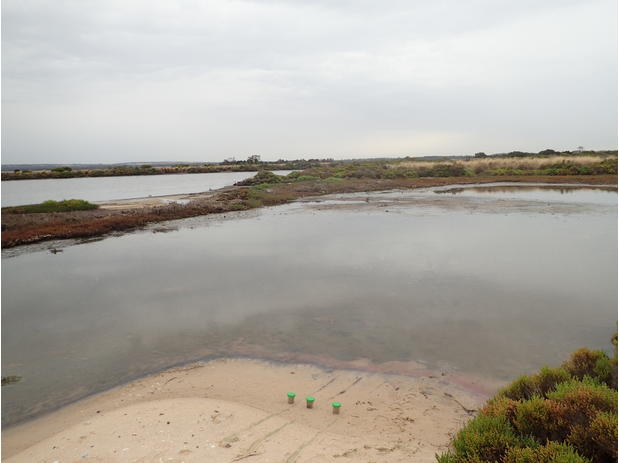
Locality: A sample site along the shore of a swiftly flowing stream in the Big Creek area near Mobile, Alabama
Coordinate Uncertainty: 50
Latitude: 30.650233
Longitude: -88.368581
Country Code: United States
Sex: Hermaphrodite
Life Stage: adult
Remarks: Images and movies documenting this specimen can be found here.
We work under continuous surveillance!
A trinational field excursion, or wormsearch, is presently happening, based in Tvärminne Zoological Station (also known as Tvärminnen eläintieteellinen asema), a former Turbellarian hotspot, when Alexander Luther was its director (1919-1954 35 years!). He produced some of the most astonishing drawings of Macrostomum species (see for instance his 1905 paper in honour of Palmén, who founded the station where we presently amaze ourselves with tiny creatures). He also described numerous species and attracted and taught several renown turbellariologists.
This wormsearch's was organized by Lukas Schärer (CH), and we finally have an expert for "The Rest" of cute worms we always find and admire namelessly (i.e. the Rhabdocoela), Tom Artois (BE). The rest of the crew consists of Bart Tessens (BE), Gregor Schulte (DE), Micha Eichmann (CH) and myself.
You can now find online a fairly complete bibliography of the Macrostomidae (including some papers on Microstomidae and the Dolichomacrostomidae). Most of the over 200 papers are also deposited as PDFs (for more detail see About the Bibliography).